Talk to your dedicated account team today
Agilent has committed expert resources to your organization to help progress your cancer research. Tell us about your needs and challenges. We’re ready to help.

Agilent’s extensive portfolio of cell analysis products allows researchers to understand the biology of cancer cells and immune response at the cellular level with unparalleled depth and precision, and in real time. Whether elucidating metabolic reprogramming, continuously monitoring T-cell killing over a period of days, or identifying and quantitating endogenous small molecule metabolites, Agilent offers complete workflow solutions with intuitive software for easy data analysis.
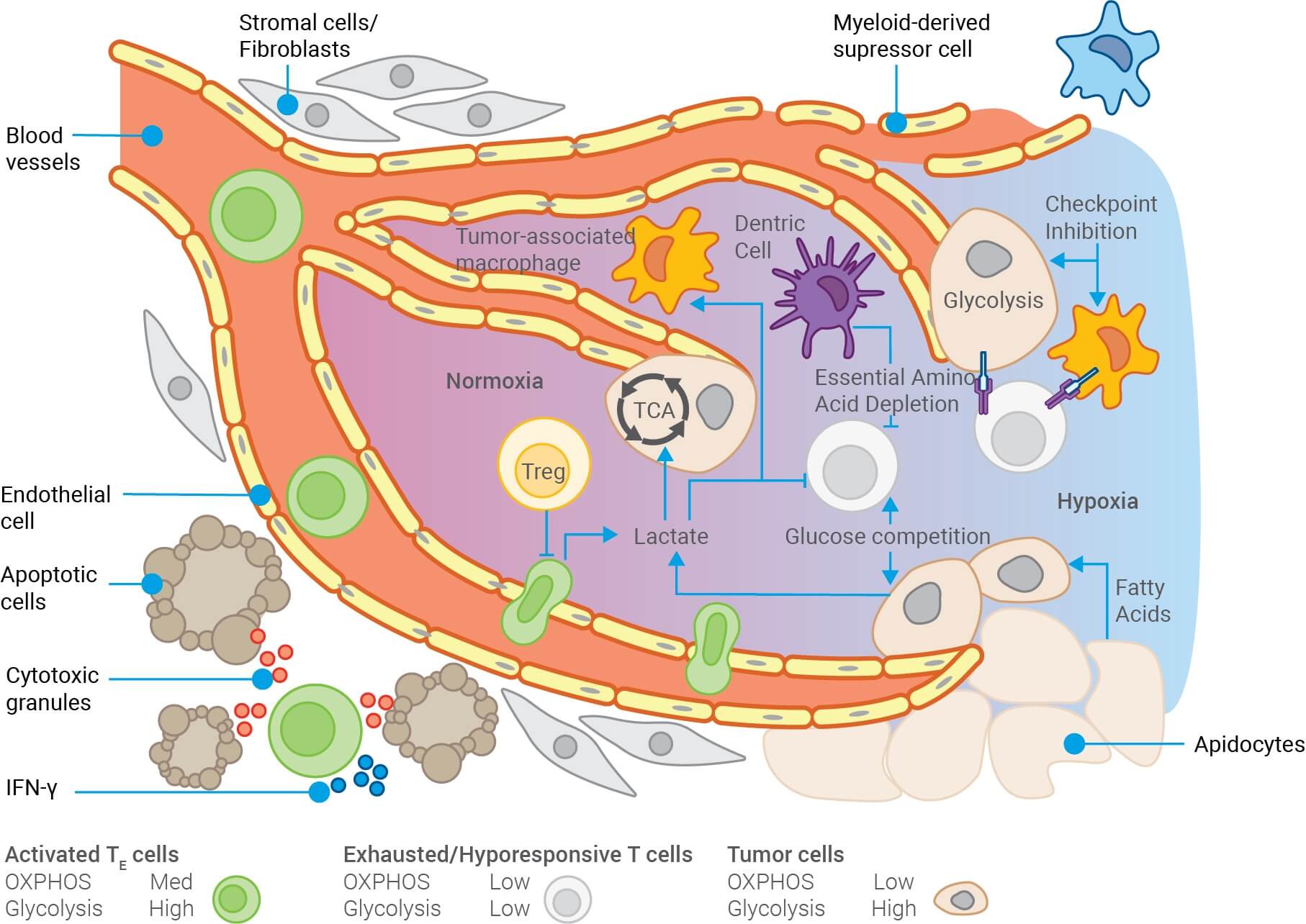
Agilent Seahorse analyzers enable label-free measurements of metabolism on cultured cells in real time, delivering functional cellular metabolic data which allows you to characterize the tumor cell’s metabolic phenotype (e.g. ratio of aerobic glycolysis to oxidative phosphorylation) with real-time kinetics. This allows cancer researchers to conduct experiments to determine how malignant transformation or genetic variation reprogram cellular metabolism, or how drug exposure alters flux through metabolic pathways. Because the Seahorse assays are non-destructive, after analysis the samples can be used for end point assays such as transcriptomics.
Agilent also now offers MitoXpress and pH Xtra, soluble sensors that enable measurement in real-time of energy flux, mitochondrial function, glycolysis and substrate utilization in living cells, isolated mitochondria, 3D cultures and microbes using a standard fluorescence plate reader.

Seahorse XFe96 Analyzers measure OCR and ECAR of live cells in a 96-well plate format. OCR and ECAR rates are key indicators of mitochondrial respiration and glycolysis. These measurements provide a systems-level view of cellular metabolism in both cultured cells and ex-vivo samples.

Seahorse XFe24 Analyzers measure OCR and ECAR of live cells in a 24-well plate format. OCR and ECAR rates are key indicators of mitochondrial respiration and glycolysis. These measurements provide a systems-level view of cellular metabolism in cultured cells and ex-vivo samples.

The newest addition to the Seahorse XF platform, the Agilent Seahorse XF HS Mini analyzer delivers the best in Seahorse XF data quality, workflow, and user experience. It enables researchers to profile cellular metabolism with greater flexibility and reliability than ever before.


The xCELLigence RTCA eSight enables comprehensive insight into cell health, behavior, and function using live, simultaneous, and real time biosensor impedance-based and image-based measurements. Continuously monitor immune cell-mediated killing of cancer cells using the label-free xCELLigence RTCA technology combined with live cell imaging in 3 colors (red, green, and blue).
Providing a direct and objective assessment of target cell number, cell size, and cell-substrate attachment strength, impedance biosensors embedded within the base of eSight microplates quantitatively track the continuum of target cell killing, spanning from early (reduced cell-substrate adhesion strength) to late (lysis) events.
Concurrently, eSight captures live cell images in brightfield and three fluorescence channels, providing an orthogonal readout of the killing process. By combining the strengths of real-time impedance monitoring (simplicity, analytical sensitivity, and objectivity) with that of live cell imaging (specificity of the readout), eSight increases the information richness of the immune cell‑killing assay without increasing the workload.

The xCELLigence RTCA eSight enables comprehensive insight into cell health, cell behavior, cell function and cell biology processes using live, simultaneous, and real time biosensor impedance-based and image-based measurements.

Agilent has a comprehensive portfolio of solutions in metabolomics, covering the entire workflow. The Bravo Metabolomics Sample Prep Platform automates plasma sample prep. The 6546 LC/Q-TOF delivers the sensitivity, resolution, dynamic range, and isotopic fidelity necessary to find and identify metabolites of interest. For targeted metabolomics and routine quantitation, the Agilent 6470A triple quadrupole LC/MS offers best-in-class performance and robustness. Coupled with cutting-edge informatics solutions, consumables and workflows, Agilent offers end-to-end workflow solutions for your metabolomics research.
In order to understand their mechanistic basis, one needs to correlate differences in cellular functionality or metabolism with changes at the genomic, proteomic and metabolomic level. Metabolomics is the most proximal to how the cell is addressing its energetic needs and is adapting to changes in its environment. Quantitative monitoring of endogenous small molecule metabolites can yield important insights into the flux through the relevant metabolic pathways leading to the observed changes in cellular metabolism, as well as important, apparently unrelated secondary changes.
Successful metabolomics experiments require robust analytical methods, instrumentation and powerful data analysis packages to extract, find and interpret the experimental results. Agilent offers a comprehensive portfolio of workflow solutions for metabolomic analysis, including the Agilent Metabolomics dMRM Database and Method, which was developed specifically for targeted LC/MS analysis of central carbon metabolites in complex biological matrices.

The Agilent Metabolomics dMRM Database and Method offers a comprehensive solution for targeted analysis of central carbon metabolites. It provides robust chromatography for over 215 metabolites with confirmed transitions and retention times for routine metabolite analysis on Agilent’s 1290 Infinity II Series LC and 6400 series LC/MS systems.


Talk to your dedicated account team today
Agilent has committed expert resources to your organization to help progress your cancer research. Tell us about your needs and challenges. We’re ready to help.