


Focus on Simplicity

Agilent SurePrint microarray success stories

rocket

Technology powered by microarrays

Microarrays are indispensable tools for multiomics analysis. Our customers use arrays across diverse domains, from microbiome testing to high-throughput proteomics and 3D genome analysis. This versatile platform empowers discoveries at various biological resolutions, from broad bulk analysis to targeted single cells.

When choosing an analytical technology, it’s important to base your decision on your specific research needs rather than being limited by the perceived capabilities of the technology itself.

By focusing on performance metrics like sensitivity, specificity, and dynamic range, this can allow you to make an informed decision on which technology best aligns to your scientific objectives.
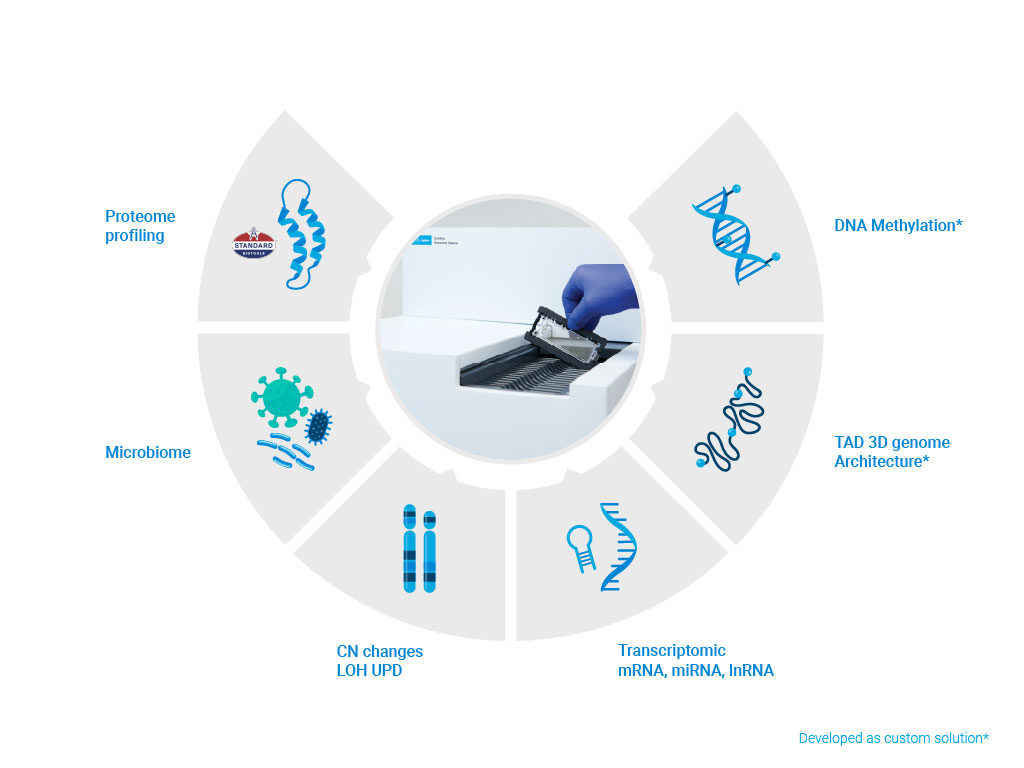
infographic

Microarray technology applications

Gene expression profiling

Gene expression arrays can provide better results with respect to RNA sequencing (RNA-Seq) for gene expression profiling. A study comparing the performance of Agilent microarray versus RNA-Seq platforms demonstrated that both methods provided similar technical ability in gene expression analysis. However, microarrays showed better sensitivity for detection of low-expressed genes.

See full study

3D genome analysis

The Oxford Biodynamics EpiSwitch Explorer Array Kit has enabled researchers to explore 3D genomic biomarker discovery at high resolution, and is compatible with Agilent SureScan microarray scanners. See how this custom microarray allows simultaneous interrogation of over 960,000 high-confidence chromosome conformations across the human genome.

See more

Circular RNA expression profiling

Circular RNAs (circRNAs) are usually present at much lower levels compared to linear RNA, making its expression profiling difficult using technologies such as RNA-Seq. Microarray accuracy remains relatively unchanged despite lower transcript levels and are an ideal solution. Arraystar Circular RNA Arrays enable systematic profiling of highly sensitive and specific circRNA expression levels from sample to data.

Learn more

Environmental monitoring

High-throughput microarray technology has significantly improved ecological monitoring by enabling high sensitivity detection in complex environmental samples, supporting pathogen discrimination. Magigene’s Cyanochip precisely identifies and quantifies cyanobacteria strains using two-color fluorescent labeling, supporting the prediction of toxic algal blooms by monitoring community changes.

Discover more

Chromatin accessibility

This study highlights the use of microarray technology to analyze genome-wide chromatin accessibility patterns, termed Assay for Transposase-Accessible Chromatin sequencing (ATAC-seq). See how ATAC-seq microarray technology can enable complex analysis with an easier workflow, simplified data analysis, and lower cost without compromising data quality in cancer research.

Read the article

Pathogen detection

Microarray hybridization-based detection offers rapid and sensitive analysis of molecules, even in highly complex samples. Agilent microarrays can be customized to target any genomic sequence, as demonstrated by the creation of the Agilent Pathochip. This innovative community-designed pathogen research microarray can detect and identify thousands of different pathogens in a single assay.

Explore the microarray

Protein-DNA interaction

Gene expression arrays can provide better results with respect to RNA sequencing (RNA-Seq) for gene expression profiling. A study comparing the performance of Agilent microarray versus RNA-Seq platforms demonstrated that both methods provided similar technical ability in gene expression analysis. However, microarrays showed better sensitivity for detection of low-expressed genes.

See full study

For research use only. Not for use in diagnostic procedures.

PR7001-3419