
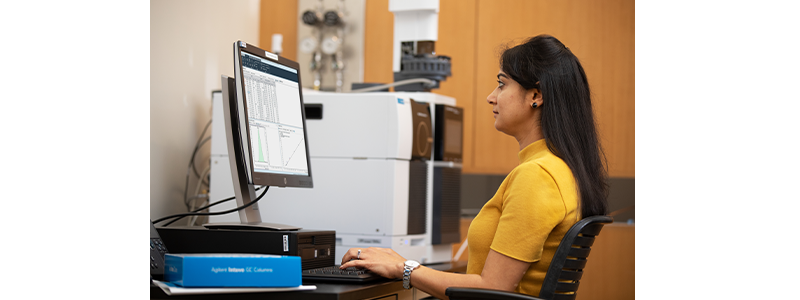
MassHunter delivers outstanding performance in all MS processes (GC & LC MS, MSMS, TOF, QTOF, and ICPMS), reducing the number of different software programs required to control and collect analytical data in your laboratory. This software suite provides detailed instrument control, monitoring, and data analysis. Please join us to discover the powerful and time saving tools found in the MassHunter software platforms of qualitative, quantitative, and unknowns data analysis.
MassHunter Qualitative Analysis: Learn Tricks for Faster Analysis of Unit and Accurate Mass Data
26 January 2026 | 2 p.m. EST
MassHunter Qualitative Analysis 10 is feature-rich mass spectrometry screening software for the confirmation of target or suspect compounds, and for the identification of unknown analytes. The software combines feature-finding algorithms, library searching, and elemental composition calculations (accurate mass data). These advanced data mining and processing options let you rapidly and accurately find all detectable compounds and easily confirm targets or identify unknowns. The workflow method setup allows data files to be automatically and reproducibly analyzed with the user-selected parameters to minimize mouse clicking and data processing time. Results can be displayed using fast, flexible data reporting with preconfigured reports that simplify basic analyses.
Multi-Component Methods in Minutes using MassHunter Quantitative Analysis
27 January 2026 | 2 p.m. EST
MassHunter Quantitative Analysis is an easy-to-learn software suite containing a variety of workflow options to easily construct data analysis methods and quickly process large batches of data. This webinar will detail the use of semi-automated peak identification and deconvolution coupled with the NIST library to rapidly build a method to identify and calibrate a series of multi-component semivolatiles standards. Options for rapid batch review will also be discussed, along with common outlier setup such as accuracy and internal standard response deviation.
MassHunter Unknowns Analysis for the Forensic Chemist-Fundamental Workflow Part I
28 January 2026 | 2 p.m. EST
The MassHunter Unknowns Analysis video Part I is designed to introduce the student to the workflows involved when using Unknowns Analysis. The video begins a 15-minute PowerPoint explanation of the deconvolution process, difference between deconvolution and peak integration, and some of the variables involved when using this powerful data analysis tool. Working through forensic data, the video is designed to help translate established workflows within ChemStation Data Analysis to MassHunter Unknowns Analysis.
MassHunter Unknowns Analysis for the Forensic Chemist-Fundamental Workflow Part II
29 January 2026 | 2 p.m. EST
The MassHunter Unknowns Analysis video Part II is designed to reinforce the workflows of Unknowns Analysis illustrated in Part I to actual forensic samples. The student will also learn how to create additional components, manually and apply background subtraction. Working through forensic data, the video is designed to help translate established workflows within ChemStation Data Analysis to MassHunter Unknowns Analysis.
For Forensic Use.
DE.011500
Matt joined Agilent in 2013 as a GC/MS Applications Scientist in the Santa Clara, CA Center of Excellence. His primary responsibility is focused on providing instrument demos for customer interested in each technology Agilent offers; the GC/MS single quadrupole, triple quadrupole and the quadrupole Time-of-Flight. The variety of different samples submitted to the demo lab provide a unique knowledge of optimizing parameters for different applications to provide the best quality data from the instrument.
Rachael Ciotti is a GC/MS Application Specialist at Agilent Technologies in Wilmington, DE. Previously, she was a Field Service Engineer specializing in installing, maintaining, and repairing Agilent GC and GC/MS systems. Prior to joining Agilent, Rachael worked at DuPont as an analytical chemist responsible for GC and GC/MS method development and transfer to manufacturing labs. She holds a Bachelor of Arts in Mathematics from Rutgers University.
Kirk received his B.S. in Forensic Science and Chemistry from Eastern Kentucky University and began working as a Forensic Drug Chemist in the Miami Valley Regional Crime Laboratory in Dayton, Ohio. He then moved to Orlando, Florida where he worked as a Forensic Toxicologist for the Florida Department of Law Enforcement in the Orlando Regional Crime Laboratory and later as a Crime Analyst Supervisor in the Pensacola Regional Crime Laboratory. Kirk left the forensic realm and began his tenure with Hewlett Packard/Agilent Technologies, working as a Customer Service Engineer (CE) supporting the LC, GC, LC/MS, GC/MS, and ICP/MS products. While working for HP Kirk earned his M.S. in Analytical Chemistry from Middle Tennessee State University and in 2005 Kirk left Agilent Technologies to attend the University of Cincinnati to earn his Ph.D. in Analytical Chemistry. After receiving his Ph.D., Kirk worked for the Midwest Research Institute (MRI) in Kansas City, MO where he worked as a Principal Chemist and Sr. Program Manager on Department of Defense projects, staffing, designing, and building remote laboratories for placement throughout the world. In 2014, Kirk re-joined Agilent Technologies as a GC/MS Applications Scientist focusing on forensic applications.