

Agilent End-to-End Digital Pathology Solutions
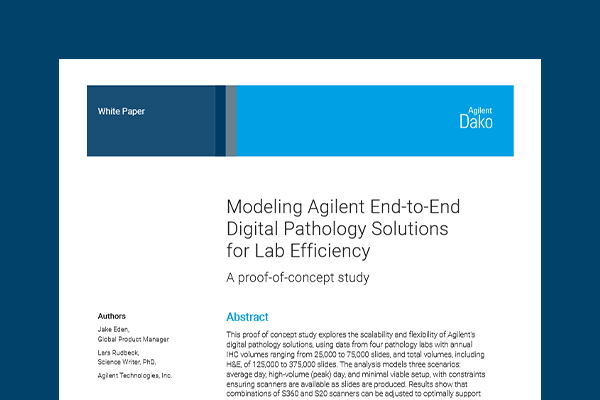
The full proof of concept study details are available in the white paper. Download it to understand the importance of having a correctly scaled digital pathology solution for your lab's needs, both now and in the future.
Have you ever wondered how to optimize digital pathology in your lab? How many scanners do you need to meet specific sign-out deadlines, and will AI analysis be done before that? Our latest proof of concept study models different scenarios based on real-world data. It shows the scalability and flexibility of our digital pathology solutions that are purpose-built to meet the unique needs of your lab.
Designing digital pathology solutions
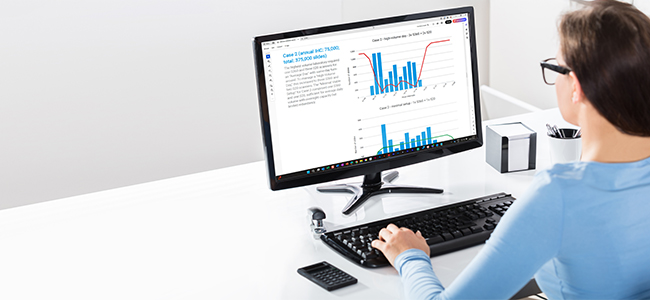
Using data from four pathology labs with varying annual slide volumes, we modeled three scenarios: average day, high-volume day, and minimal viable setup. The results show how combinations of whole slide scanners can be adjusted to support different workload scenarios, ensuring efficient workflows and timely results.
Our cloud-based Proscia Concentriq AP image management software demonstrated seamless integration with Visiopharm AI analysis, automating the ingestion, processing, and upload of slide data. This study illustrates Agilent's capacity to design flexible, scalable, and interoperable digital pathology solutions that match your lab's specific throughput, budget, and turnaround time requirements.
This white paper outlines a proof of concept study based on theoretical modeling data. It is intended to demonstrate technical feasibility and any workflow described should not be interpreted as validated for clinical or diagnostic use.
The digital pathology solutions are not available in all markets and may have different regulatory statuses. Please check with your local Agilent representative for availability in your country.
D0133642_1.00
Add your details below to download the white paper.