From Analysis to Experience: A Science Double Feature

Date: Monday, August 31st, 2026
Time: 11:45 a.m. - 12:45 p.m.
Location: Grand Ballroom 8
Untargeted chemical profiling using advanced GC–MS and LC–MS provides a powerful framework to link complex chemical composition with functional and sensory outcomes. This presentation highlights a flavoromics approach integrating high-resolution mass spectrometry, chemometrics, and targeted isolation to discover key marker compounds from large datasets. Case studies in coffee and cereal systems demonstrate how statistically derived features can be translated into chemically identified drivers of quality and preference. Emphasis will be placed on data workflows, feature extraction, and modeling strategies that transform untargeted profiles into actionable insights for food quality and product innovation.
We are presenting a method for pesticide analysis in challenging matrices of oleoresins, essential oils and raw spices and herbs using an Agilent 7890B GC with a multimode inlet (MMI), mid-column backflush, and a 7000E triple quadrupole MS/MS equipped with a HydroInert electron ionization source. To address helium supply limitations and improve analytical robustness, hydrogen is used as the carrier gas. The use of hydrogen self-cleans the ion source and enables sharper chromatography, and faster run times. This configuration has proven essential for achieving reliable detection at levels around 100 ppb in these difficult sample types. Our results demonstrate that hydrogen not only replaces helium but actively enhances method performance for routine pesticide monitoring. For matrices containing high concentrations of carotenoids, QuEChERS sample preparation involves additional clean-up with SPE. We will present results and LOQs and discuss further improvement of sensitivity through an upgrade to the HES 2.0 ion source.
DE-016093
Devin Peterson is a CFAES Distinguished Professor at The Ohio State University and a leading expert in flavor science. He pioneered flavoromics, a molecular to sensory framework that identifies chemical drivers of flavor perception, and his research spans taste, smell, somatosensation, and flavor modulation to improve food quality and consumer acceptance. He has received multiple national awards, founded the Flavor Research and Education Center, directs the OSU Foods for Health Initiative, and has published more than 125 peer‑reviewed articles.
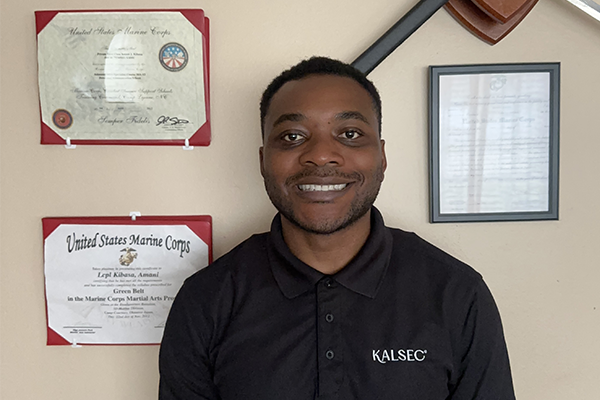
Amani Kibasa is an experienced Associate Scientist with deep expertise in GC-MS/MS and a broad range of injection techniques: liquid injection, SPME Arrow, and static headspace for the past five years. At Kalsec, he developed and applied numerous analytical methods to solve complex problems. He received his BA in Chemistry from the University of Iowa, while supporting research in inorganic chemistry resulting in an article titled: Stable M(II)-Radicals and Nickel(III) Complexes of a Bis(phenol) N-Heterocyclic Carbene Chelated to Group 10 Metal Ions. As a member of the US Marine Corps, he served honorably as a defense travel system specialist under an inspector general, bringing a strong foundation in compliance, process integrity, and attention to detail to every lab workflow.